
How Municipal Court Warrants Work
Kiowa County's municipal courts handle town ordinances and municipal traffic matters. Miss a summons-based appearance there and a judge can issue a bench warrant. A bench warrant is a judge's arrest order. Capias pro fine is not the label Colorado uses. Ask the issuing town court how the record reads: bench warrant, failure to appear, active, served, recalled, or quashed. A municipal case does not become a District Court case just because the court sits in Kiowa County. The Colorado County Court at the Kiowa County Combined Court handles state misdemeanors, petty offenses, traffic cases, and initial criminal matters. District Court takes the felonies. Check the court named on the citation.
Kiowa County Municipal Warrant Venues
Eads Municipal Court and Kiowa County Combined Court are separate offices. Eads holds the town ordinance and municipal traffic files. The Combined Court houses Colorado District Court and County Court functions. Read the ticket's heading first.
| Venue | Typical record | Contact |
|---|---|---|
| Eads Municipal Court | Eads ordinance and municipal traffic cases | 719-438-5590 |
| Kiowa County Court | State misdemeanor, petty-offense, and traffic cases | 719-931-6010 |
| Kiowa District Court | Felony and other district matters | 719-931-6010 |
The Kiowa County Sheriff can route a warrant question. But only the issuing municipal judge controls a reset, recall, payment, appearance, or court order.
Municipal Courts Across Kiowa County
Kiowa County's municipal layer covers three towns, and each takes a different amount of care. Eads is the easy one. It publishes working local contacts, so you can ask its court directly about a town citation or ordinance case. Haswell is different. Its listing in the Colorado Municipal Judges Association directory confirms that a municipal court exists, but the town posts no warrant desk, judge, hours, fee schedule, or search form. Sheridan Lake appears in the Colorado Municipal League directory as a statutory town. It publishes no public warrant contact either. So the safest opening move in those two towns is the current town clerk or the Kiowa County Sheriff. Name the town and case. Ask for the current municipal court contact before you mail documents or drive over. Do not skip that step. Of the three, only Eads carries a direct local court address, phone, and hours in official local sources. Haswell and Sheridan Lake surface only through the municipal directories. No town in Kiowa County offers a public warrant lookup. That makes the phone call the whole warrant search.
| Town | Municipal court finding | Warrant route | Published phone |
|---|---|---|---|
| Eads | Municipal court confirmed locally | Call court for ordinance or town traffic case | 719-438-5590 |
| Haswell | Statewide directory entry | Verify current clerk or ask sheriff to route | Not found in reviewed sources |
| Sheridan Lake | Municipal directory layer | Verify current town court or ask sheriff | Not found for warrant inquiries |
Do not guess a date, bond, fee, or walk-in rule that a Kiowa County town has not published.
Kiowa County Municipal Warrant Contact
The Kiowa County Sheriff local-information page lists Eads Municipal Court at 110 West 13th Street, Eads, Colorado 81036. Call 719-438-5590; the fax is 719-438-5652. Hours run Monday through Thursday, 8:00 a.m. to 4:30 p.m., and the office is closed Friday. Call before you appear.
Ask the Kiowa County court staff whether an FTA warrant exists, whether payment is still an option, whether a new date can be set, and whether a judge must act. An office listing is not a warrant roster.
Kiowa County Municipal Warrant Checks
No sheriff list, city portal, or statewide Colorado warrant database replaces direct municipal confirmation in Kiowa County. Match the channel to the case.
- Read the citation, summons, notice, or payment paper for the town and case number.
- Call the named municipal court or current town clerk. For Eads, use 719-438-5590.
- Ask whether a failure-to-appear warrant is active and what the judge requires.
- Call the Kiowa County Sheriff at 719-438-5411 for service or routing questions.
- If the paper is a state case, call Combined Court instead at 719-931-6010.
- Request the document from the office that actually keeps it.
Dispatch is not the routine warrant line. 911 is for emergencies only, and a clear Kiowa County docket result does not clear a town warrant.
No Kiowa County Municipal Warrant Roster
Kiowa County publishes no municipal warrant roster. The sheriff posts general contacts and a records process, not a complete list. Colorado Docket Search covers court calendars. It is not a city warrant-status database. So a municipal record can sit outside both the state docket view and the sheriff's public pages.
Key point: Absence from a sheriff page or state docket is not proof that no municipal warrant exists.
The city court record holds the answer. If you cannot find a court contact, the Kiowa County Sheriff can route the inquiry and the current town clerk can name the municipal channel. An unofficial directory is never final status.
Municipal Warrants: What They Show
A Kiowa County municipal warrant file can show the issuing court, the person or case, the town charge, the citation number, the required appearance, and the FTA event. It may also carry the warrant order, bond or release instruction, signature, and return of service. No local status-code table or sample number is published. Use the court's exact terms.
| Court | The town court whose judge issued the order. |
|---|---|
| Case or citation | The identifier printed on the municipal paper. |
| Underlying matter | Town ordinance or municipal traffic allegation. |
| FTA event | The missed date or response recorded by the court. |
| Warrant status | Active, served, recalled, or quashed only when the court confirms it. |
| Required action | Payment, reset, appearance, motion, arrest, or bond as ordered. |
In Kiowa County terms, recall means the court withdraws the warrant. Quash means a court order sets it aside.
Kiowa County Municipal Warrant Requests
Two different record laws meet in Kiowa County. Sheriff files fall under the Colorado Criminal Justice Records Act. State court records follow Colorado Judicial Branch Chief Justice Directive 05-01 and the court rules that apply to those files. A town municipal court may keep its own clerk and its own request instructions. That split matters when you chase a warrant record. So ask first which office created the file you want. A sheriff report request will not pull a court order or a municipal case register. When you write to any office, name the town, court, citation or case number, filing year, party, approximate date, and document type when you know them. If access gets denied or trimmed, ask the custodian which statute, rule, order, or privacy limit controls the answer. Eads offers no online municipal warrant request form, so its clerk is the place to ask. Haswell and Sheridan Lake run through their own town courts the same way. For a state County Court document in Kiowa County, use the Colorado Judicial Branch request form and select Kiowa County from the county list. The form accepts a case number, filing year, case type, party name, county, and date of birth when known. The form itself makes the boundary plain: it belongs to state court files, not to an Eads, Haswell, or Sheridan Lake municipal case.
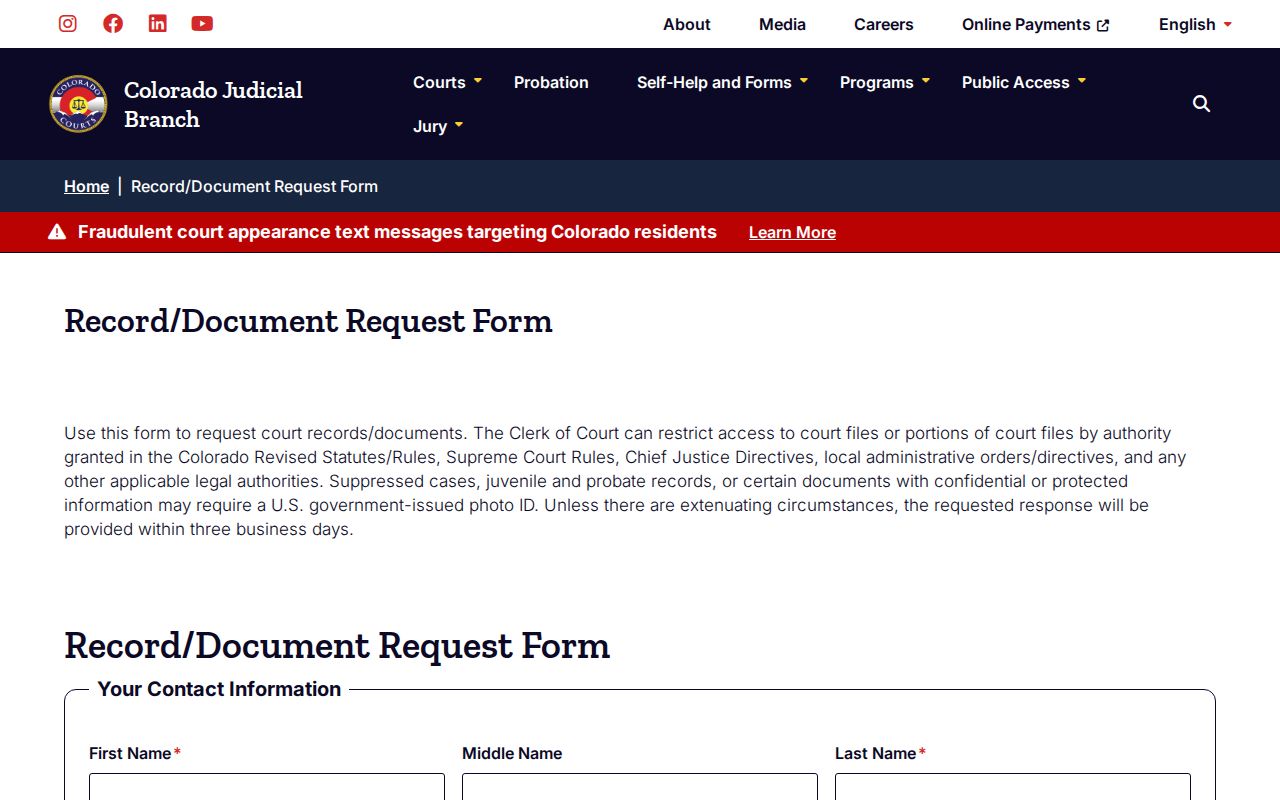
Expect a response within three business days. Absent unusual circumstances, that is the norm; the form itself does not recall a Kiowa County municipal warrant and may not hold a town file at all.
Kiowa County Municipal Warrant Payment
In Kiowa County, resolving a municipal case should end with proof from the issuing court itself. A phone call can map the next step. It is not the final record. Ask whether the judge signed a recall or quash order, whether the warrant was served, and when the court system will show the change. Keep every new piece of paper: the appearance notice, payment receipt, motion, judicial order, or bond paperwork. Then confirm the status again with the municipal clerk. If the sheriff held the warrant for service, ask whether the sheriff's record has caught up too. Kiowa County publishes no standard removal timetable, so an online or phone status will not always move at once. Even a payment that settles the full amount does not prove a judge withdrew the warrant. The Kiowa County-linked GovPayNow form is only a citation-payment channel. It is not an Eads municipal warrant lookup, and it is not a recall order. Ask the town court whether online payment even applies to its case first. If payment is allowed, save the receipt, case number, and date. Then ask for written confirmation of the next appearance and the current warrant status. The court may still require a reset, a personal appearance, a motion, or a judge's order. A clerk can explain the procedure. No office employee can promise a judicial result. Note: the payment screen answers how money is submitted, while the issuing municipal court answers whether its warrant has changed.
Clearing a Municipal Court Warrant
Call the court before you travel. Ask whether a counter appearance could lead to immediate custody, whether counsel can arrange a walk-through, and whether the judge will consider a new date or a motion. Kiowa County has no jail. So also ask the sheriff where booking would occur if arrest is required.
- Confirm the town, case number, warrant type, and active status.
- Ask the municipal clerk which payment, reset, motion, or appearance process applies.
- Ask whether a lawyer can coordinate the appearance and whether bond is set.
- Complete the court-ordered act and keep all receipts and orders.
- Confirm recall or service with both the municipal court and sheriff.
Call first: Kiowa County municipal courts publish no universal surrender window, recall form, bond schedule, or online warrant list.
For the wider Kiowa County process, review the Kiowa County warrant resolution route, and keep each later court date.